Pompeii and Herculaneum day trip

from $423.61
Free cancellation up to 24 hours before
Overview
Stopped in their tracks by the eruption of Mount Vesuvius in A.D. 79, Herculaneum and Pompeii offer the best look anywhere at what life in Rome must have been like around 2,000 years ago.
6 hours
Pickup offered
Itinerary
- 1Stop
You will meet a licensed guide, after purchasing tickets, the tour begins and you will be led by the guide through the ruins of this amazing ancient town.
- 2Stop
The Civil Forum is the core of daily life in the city and is the focal point of all the main public buildings for city administration and justice, business management, and trade activities such as markets, as well as the main places of citizen worship.
- 3Via dell’Abbondanza
Via dell'Abbondanza (or street of abundance), the most prosperous street in Pompeii.
- 4Stop
The theatre area of Pompeii. Three main buildings make up this area: the Large Theatre, the Odeon (small theatre), and the Quadriporticum. These served as an entertainment and meeting centre of the city.
- 5Casa del Menandro
one of the richest and most magnificent houses in ancient Pompeii in terms of architecture, decoration and contents, and covers a large area of about 1,800 square metres (19,000 sq ft)
- 6Stabian Baths (Terme Stabiane)
a perfect sample of a Roman bathing complex in Pompeii, Italy, the oldest and the largest of the 5 public baths in the city.
- 7Lupanar
The Lupanar of Pompeii is the ruins of a brothel in the Ancient Roman city of Pompeii. It is of particular interest for the erotic paintings on its walls. Lupanar is Latin for "brothel". The Pompeii lupanar is also known as Lupanare Grande or the "Purpose-Built Brothel".
- 8Pompei
The Antiquarium of Pompeii began as an exhibition venue displaying archaeological finds that represented the daily life of the ancient city. Visitors can see archaeological discoveries from the excavations, casts of the victims of the Mount Vesuvius eruption as well as displays documenting Pompeii's settlement history before becoming a thriving Roman city.
- 9Archeological Park of Herculaneum
The Archeological site of Herculaneum (in Italian: Scavi di Ercolano) is the area south of the town centre of modern Ercolano where the Roman town of Herculaneum has been excavated. Herculaneum was destroyed and buried by lava and mud during the eruption of Mt. Vesuvius in AD 79 together with Pompeii, Stabiae and Oplontis. In 1997 the Herculaneum site was listed as a World Heritage Site by UNESCO. Although Herculaneum was discovered before Pompeii, the excavation was so difficult that it was repeatedly interrupted in favour of the easier excavation of Pompeii. Herculaneum is smaller and less famous than Pompeii, but better preserved due to the different volcanic materials that covered the town.
- 10Stop
the ruins of a big house for the wealthy.
- 11Stop
The House of the Wooden Tramezzo was built in the pre-Roman age, around the 1st century BC. The house has a typical patrician facade that ends with an oval cornice while at the base it has masonry seats used by waiting clientes before being received by the owner; along the walls of the entrance jaws there remain traces of stucco on which frescoes had been made, but these are faded by time. On the east side of the atrium is the tablinum: the two rooms are divided by means of a partition, i.e., a kind of folding door, as tall as a man, made entirely of wood, charred as a result of the eruption, with shaped doors and large bronze rings on which lamps were rested.
- 12Stop
Main street.
- 13Stop
The College of the Augustals was built at the end of the first century B.C., probably around 14 B.C., in the Augustan period, during the redevelopment of the entire area[2]: the building was desired and financed by the two brothers A. Lucius Proculus and A. Lucius Iulianus, who also offered, on the day of the inauguration, a banquet to both the Augustals and the decurions, as stated in an epigraph found on November 25, 1960, about two meters above the floor and today placed on a side wall of the College
- 14Stop
Public bathhouse.
- 15Antiquarium di Ercolano
A museum, holding, among the others, an amazing collection of objects found next to the skeletons.
What's included
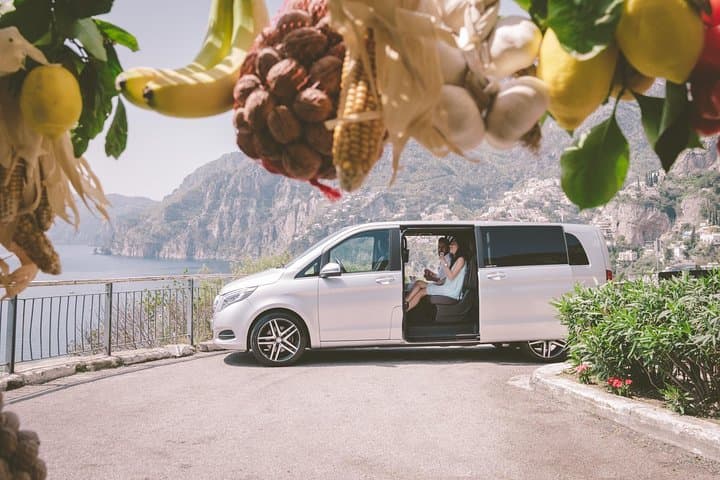
- Private transportation
- Professional guide at the ruins (if option that includes the guide is selected)
- Bottled water
- Air-conditioned vehicle
- All Naples' Hotels - Ports - Train station - Airport pickup and drop-off
Not included
- Lunch
- Access fees to Ruins and Monuments ( € 18 and 16 - Visitors younger than 18 free of charge)
- Professional guide at the ruins (if option including the guide is not selected)
- Porta Marina
Good to know
- Wheelchair accessible
- Infants and small children can ride in a pram or stroller
- Service animals allowed
- Public transportation options are available nearby
- Transportation options are wheelchair accessible
- Suitable for all physical fitness levels
- In accordance with the current italian laws, due to Corona virus pandemic, passengers must wear a mouth mask when travelling on a private vehicle.